
291 lines
9.4 KiB
Markdown
291 lines
9.4 KiB
Markdown
|
||
|
||
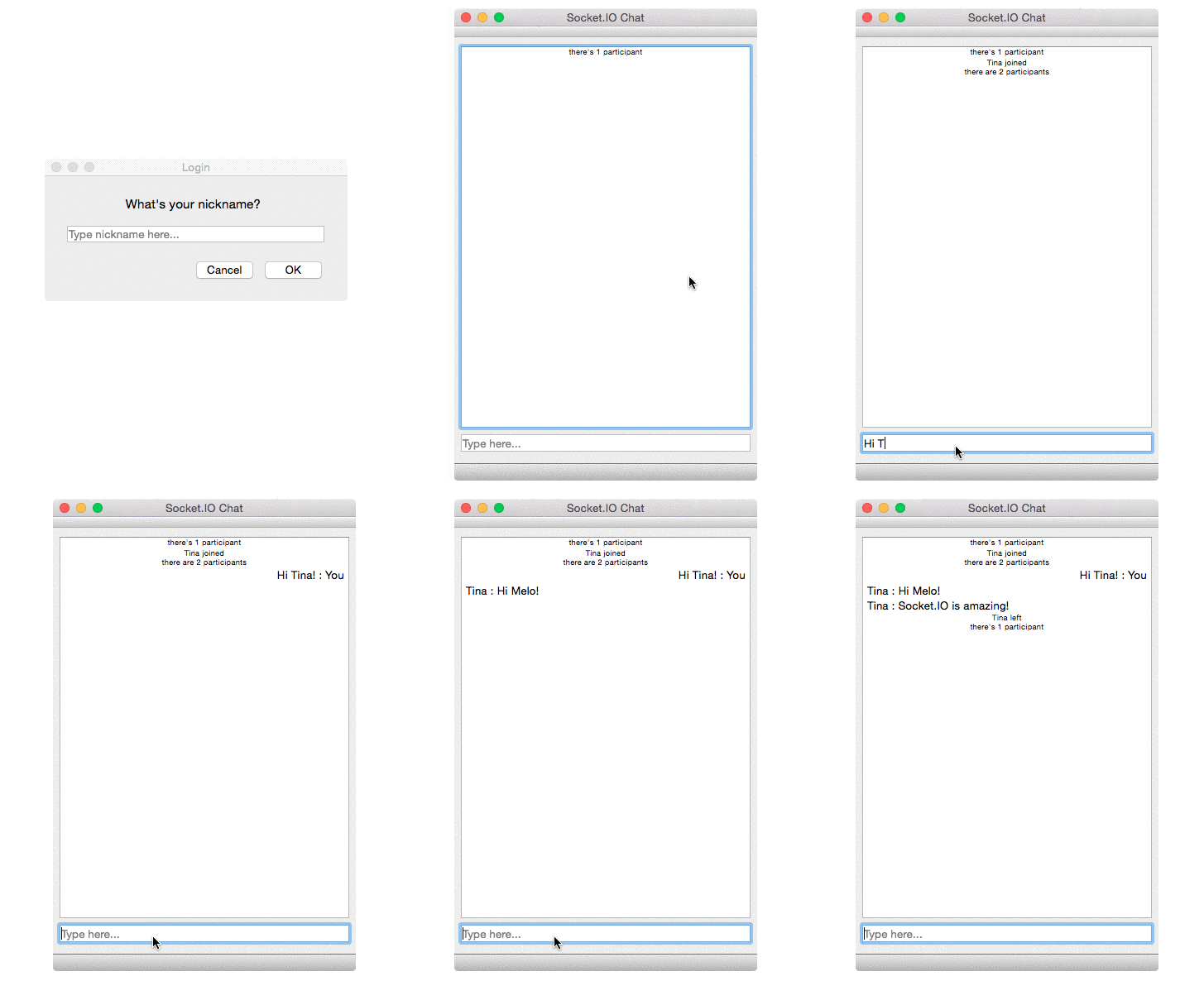
In this tutorial we’ll learn how to create a QT chat application that communicates with a [Socket.IO Node.JS chat server](https://github.com/Automattic/socket.io/tree/master/examples/chat).
|
||
|
||
### Introduction
|
||
To follow along, start by cloning the repository: [socket.io-client-cpp](https://github.com/socketio/socket.io-client-cpp).
|
||
Using:
|
||
|
||
```bash
|
||
git clone --recurse-submodules https://github.com/socketio/socket.io-client-cpp.git
|
||
```
|
||
|
||
The app has the following features:
|
||
|
||
* Sending a message to all users joining to the room.
|
||
|
||
* Notifies when each user joins or leaves.
|
||
|
||
* Notifies when an user start typing a message.
|
||
|
||
###Install QT community
|
||
Visit [QT community download link](http://www.qt.io/download-open-source/#section-2) to get the install package.
|
||
Just install it with default installation option.
|
||
|
||
###Create a QT GUI application.
|
||
Launch QT Creator.
|
||
In welcome page, select `New Project`, create a `QT Widget Application`, named it `SioChatDemo`
|
||
The project structure is like:
|
||
|
||
```
|
||
SioChatDemo
|
||
|__ SioChatDemo.pro
|
||
|__Headers
|
||
| |__mainwindow.h
|
||
|__Sources
|
||
| |__main.cpp
|
||
| |__mainwindow.cpp
|
||
|__Forms
|
||
|__mainwindow.ui
|
||
```
|
||
|
||
### Import SioClient and config compile options.
|
||
Let's copy the SioClient into the QT project as a subfolder `sioclient`.
|
||
|
||
Edit `SioChatDemo.pro` to config paths and compile options, simply add:
|
||
|
||
```bash
|
||
SOURCES += ./sioclient/src/sio_client.cpp \
|
||
./sioclient/src/sio_packet.cpp
|
||
|
||
HEADERS += ./sioclient/src/sio_client.h \
|
||
./sioclient/src/sio_message.h
|
||
|
||
INCLUDEPATH += $$PWD/sioclient/lib/rapidjson/include
|
||
INCLUDEPATH += $$PWD/sioclient/lib/websocketpp
|
||
```
|
||
|
||
Also add two additional compile option
|
||
|
||
```bash
|
||
CONFIG+=no_keywords
|
||
CONFIG+=c++11
|
||
```
|
||
|
||
`no_keywords` is for preventing qmake treat some function's name `emit` as the keyword of signal-slot mechanism.
|
||
`c++11` ask for C++11 support.
|
||
|
||
### Make up mainwindow ui.
|
||
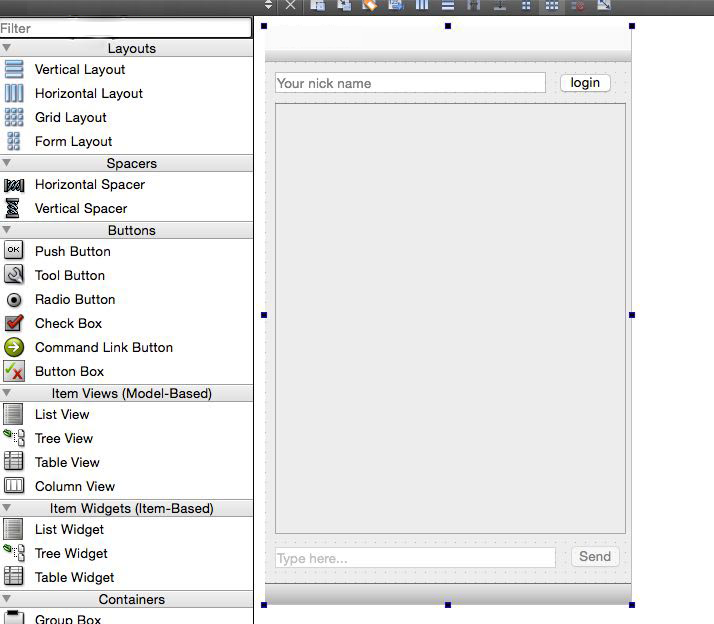
Make up a simple ui by drag and drop widget from `Widget box` in left side.
|
||
|
||
We finally end up with this:
|
||
|
||
|
||
|
||
It contains:
|
||
|
||
* a `QLineEdit` at the top for nickname inputing, named `nickNameEdit`
|
||
|
||
* a `QPushButton` at the topright for login, named `loginBtn`
|
||
|
||
* a `QListWidget` at the center for showing messages, named `listView`
|
||
|
||
* a `QLineEdit` at the bottom for typing message, named `messageEdit`
|
||
|
||
* a `QPushButton` at the bottomright for sending message, named `sendBtn`
|
||
|
||
### Add Slots in mainwindow
|
||
Slots need to be added in `mainwindow` class to handle UI events.They are
|
||
|
||
* click login button
|
||
|
||
* click send message button
|
||
|
||
* text change in messageEdit(for typing status)
|
||
|
||
* message editing is returned (for sending message by return)
|
||
|
||
Insert following code into `MainWindow` class in `mainwindow.h`
|
||
|
||
```C++
|
||
public Q_SLOTS:
|
||
void SendBtnClicked();
|
||
void TypingChanged();
|
||
void LoginClicked();
|
||
void OnMessageReturn();
|
||
```
|
||
|
||
### Connect UI event signal and slots together
|
||
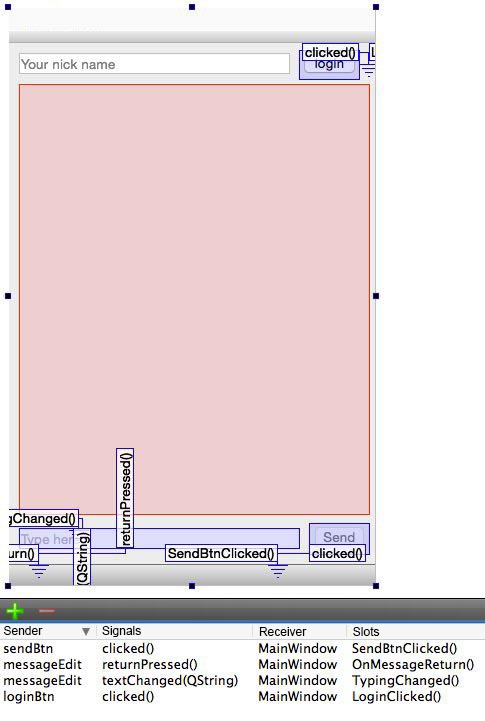
Open `mainwindow.ui` in Design mode. switch to `signals/slots` mode by check `Menu->Edit->Edit Signals/Slots`
|
||
|
||
By press left mouse on widget and drag on to the window (cursor will become a sign of electrical ground), to open the connection editor.
|
||
|
||
In the connection editor, edit the slots of MainWindow at the right side, add Those slots function name added in `mainwindow.h` before.
|
||
|
||
Then we'll be able to connect the event signal from widget with our own slots.
|
||
|
||
We finally end up with this:
|
||
|
||
|
||
|
||
### Adding UI refresh Signals/Slots
|
||
`sio::client`'s callbacks are not in UI thread. However, UI is required to be updated by those callbacks, so we need some `Signal` for non-UI thread to "request" `Slots` functions been called in UI thread. Say if we want to signal `QListWidgetItem` being added, add:
|
||
|
||
```C++
|
||
//In mainwindow.h
|
||
Q_SIGNALS:
|
||
void RequestAddListItem(QListWidgetItem *item);
|
||
private Q_SLOTS:
|
||
void AddListItem(QListWidgetItem *item);
|
||
```
|
||
|
||
```C++
|
||
//In mainwindow.cpp
|
||
void MainWindow::AddListItem(QListWidgetItem* item)
|
||
{
|
||
this->findChild<QListWidget*>("listView")->addItem(item);
|
||
}
|
||
```
|
||
|
||
Then connect them in `MainWindow` constructor.
|
||
|
||
```C++
|
||
connect(this,SIGNAL(RequestAddListItem(QListWidgetItem*)),this,SLOT(AddListItem(QListWidgetItem*)));
|
||
```
|
||
|
||
### Init sio::client in MainWindow
|
||
For single window applications, simply let `MainWindow` class holding the `sio::client` object:
|
||
|
||
declare a `unique_ptr` member of `sio::client` and Several event handling functions in `mainwindow.h`
|
||
|
||
```C++
|
||
private:
|
||
void OnNewMessage(std::string const& name,message::ptr const& data,bool hasAck,message::ptr &ack_resp);
|
||
void OnUserJoined(std::string const& name,message::ptr const& data,bool hasAck,message::ptr &ack_resp);
|
||
void OnUserLeft(std::string const& name,message::ptr const& data,bool hasAck,message::ptr &ack_resp);
|
||
void OnTyping(std::string const& name,message::ptr const& data,bool hasAck,message::ptr &ack_resp);
|
||
void OnStopTyping(std::string const& name,message::ptr const& data,bool hasAck,message::ptr &ack_resp);
|
||
void OnLogin(std::string const& name,message::ptr const& data,bool hasAck,message::ptr &ack_resp);
|
||
void OnConnected();
|
||
void OnClosed(client::close_reason const& reason);
|
||
void OnFailed();
|
||
|
||
std::unique_ptr<client> _io;
|
||
```
|
||
|
||
Init `sio::client` and setup event bindings for default `socket` in `MainWindow` constructor.
|
||
|
||
And we also need to handle the connectivity events, handle the connect and disconnect events.
|
||
|
||
Now the `MainWindow` constructor:
|
||
|
||
```C++
|
||
MainWindow::MainWindow(QWidget *parent) :
|
||
QMainWindow(parent),
|
||
ui(new Ui::MainWindow),
|
||
_io(new client())
|
||
{
|
||
ui->setupUi(this);
|
||
using std::placeholders::_1;
|
||
using std::placeholders::_2;
|
||
using std::placeholders::_3;
|
||
using std::placeholders::_4;
|
||
socket::ptr sock = _io->socket();
|
||
sock->on("new message",std::bind(&MainWindow::OnNewMessage,this,_1,_2,_3,_4));
|
||
sock->on("user joined",std::bind(&MainWindow::OnUserJoined,this,_1,_2,_3,_4));
|
||
sock->on("user left",std::bind(&MainWindow::OnUserLeft,this,_1,_2,_3,_4));
|
||
sock->on("typing",std::bind(&MainWindow::OnTyping,this,_1,_2,_3,_4));
|
||
sock->on("stop typing",std::bind(&MainWindow::OnStopTyping,this,_1,_2,_3,_4));
|
||
sock->on("login",std::bind(&MainWindow::OnLogin,this,_1,_2,_3,_4));
|
||
//default socket opened, also we have "set_open_listener" for monitoring physical connection opened.
|
||
_io->set_socket_open_listener(std::bind(&MainWindow::OnConnected,this,std::placeholders::_1));
|
||
//physical connection closed or drop.
|
||
_io->set_close_listener(std::bind(&MainWindow::OnClosed,this,_1));
|
||
//physical connection fail to establish.
|
||
_io->set_fail_listener(std::bind(&MainWindow::OnFailed,this));
|
||
connect(this,SIGNAL(RequestAddListItem(QListWidgetItem*)),this,SLOT(AddListItem(QListWidgetItem*)));
|
||
}
|
||
```
|
||
|
||
### Managing connection state
|
||
We have several connection listeners for connection events.
|
||
|
||
First we want to send login message once we're connected, get the default `socket` from `client` to do that.
|
||
|
||
```C++
|
||
void MainWindow::OnConnected()
|
||
{
|
||
QByteArray bytes = m_name.toUtf8();
|
||
std::string nickName(bytes.data(),bytes.length());
|
||
_io->socket()->emit("add user", nickName);
|
||
}
|
||
```
|
||
|
||
Then if connection is closed or failed, we need to restore to the UI before connect.
|
||
|
||
```C++
|
||
void MainWindow::OnClosed(client::close_reason const& reason)
|
||
{
|
||
//restore UI to pre-login state
|
||
}
|
||
|
||
void MainWindow::OnFailed()
|
||
{
|
||
//restore UI to pre-login state
|
||
}
|
||
|
||
```
|
||
|
||
If `MainWindow` is exit, we need to clear event bindings and listeners.
|
||
|
||
the `sio::client` object will be destruct by `unique_ptr`
|
||
|
||
```C++
|
||
MainWindow::~MainWindow()
|
||
{
|
||
_io->socket()->off_all();
|
||
_io->socket()->off_error();
|
||
delete ui;
|
||
}
|
||
```
|
||
|
||
### Handle socket.io events
|
||
We'll need to handle socket.io events in our functions bind to socket.io events.
|
||
For example, we need to show received messages to the `listView`
|
||
|
||
```C++
|
||
void MainWindow::OnNewMessage(std::string const& name,message::ptr const& data,bool hasAck,message::ptr &ack_resp)
|
||
{
|
||
if(data->get_flag() == message::flag_object)
|
||
{
|
||
std::string msg = data->get_map()["message"]->get_string();
|
||
std::string name = data->get_map()["username"]->get_string();
|
||
QString label = QString::fromUtf8(name.data(),name.length());
|
||
label.append(':');
|
||
label.append(QString::fromUtf8(msg.data(),msg.length()));
|
||
QListWidgetItem *item= new QListWidgetItem(label);
|
||
//emit RequestAddListItem signal
|
||
//so that 'AddListItem' will be executed in UI thread.
|
||
Q_EMIT RequestAddListItem(item);
|
||
}
|
||
}
|
||
```
|
||
|
||
### Sending chat message
|
||
When `sendBtn` is clicked, we need to send the text in `messageEdit` to chatroom.
|
||
Add code to `SendBtnClicked()`:
|
||
|
||
```C++
|
||
void MainWindow::SendBtnClicked()
|
||
{
|
||
QLineEdit* messageEdit = this->findChild<QLineEdit*>("messageEdit");
|
||
QString text = messageEdit->text();
|
||
if(text.length()>0)
|
||
{
|
||
QByteArray bytes = text.toUtf8();
|
||
std::string msg(bytes.data(),bytes.length());
|
||
_io->socket()->emit("new message",msg);//emit new message
|
||
text.append(":You");
|
||
QListWidgetItem *item = new QListWidgetItem(text);
|
||
item->setTextAlignment(Qt::AlignRight);
|
||
Q_EMIT RequestAddListItem(item);
|
||
messageEdit->clear();
|
||
}
|
||
}
|
||
```
|
||
|
||
### Further reading
|
||
You can run [Demo project](https://github.com/socketio/socket.io-client-cpp/tree/master/examples/QT/SioChatDemo) to have a closer look.
|
||
Before running, please follow the [instructions](../../README.md#with_cmake) to make the sioclient library.
|
||
|